
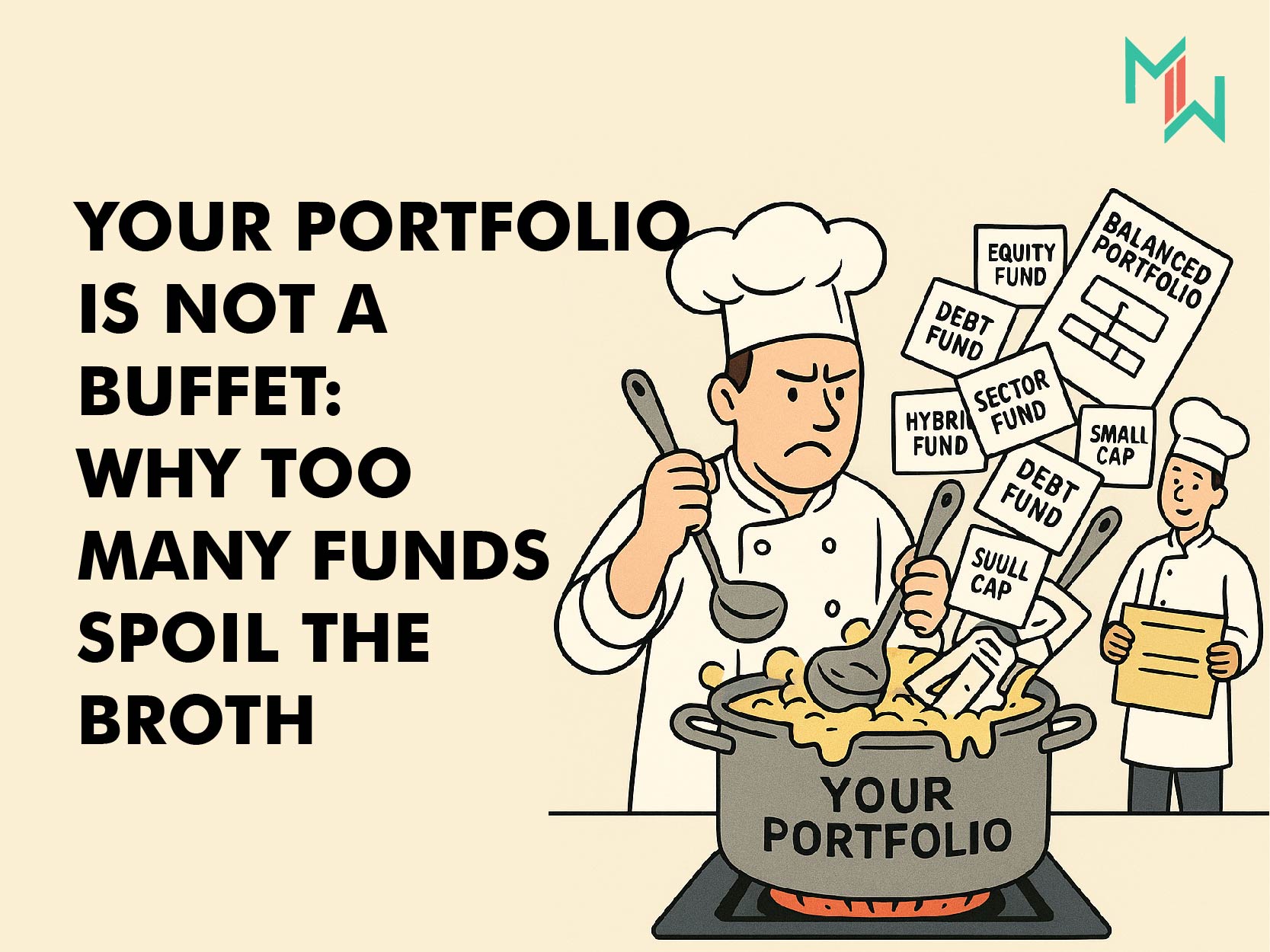
The Buffet Problem in Investing
You start with a few dishes you love… but soon, you’ve piled your plate with so much that flavors clash, food goes cold, and you can’t finish half of it. Investing can be the same—loading up on too many funds may feel exciting, but in reality, it can spoil the results.
Why 2025 Reinforces the Case for Smart Diversification
2025 has been a reality check. Trade tariffs, persistent inflationary pressures and geopolitical shocks tore off the band-aid on a simple truth: placing big bets on one sector or one asset can blow up a portfolio when that area falters. A thoughtfully diversified portfolio doesn’t eliminate risk — it cushions it, letting gains in one area offset losses in another and helping you sleep when markets get choppy.
But diversification isn’t about owning more. It’s about owning better. Too much of it can harm returns — a trap called overdiversification or “diworsification.”
The Ideal Diversification Mix: It’s Personal
Your optimal allocation depends on age, goals, risk appetite, income and tax situation. Broad guides:
Early Career (20s–30s): Growth mode
- 80–90% equities; 10–20% debt/liquid assets.
Why: time is on your side — compounding and recovery from volatility work for you.
Mid-Career (30s–50s): Balance growth & stability
- 60–75% equities; 25–40% debt, gold, hybrid funds, REITs.
Why: juggling responsibilities — stability matters as much as growth.
Pre-Retirement (50s–60s): Preservation mode
- 40–60% equities; 40–60% debt, bonds, gold, annuities.
Why: focus shifts to steady income and lower volatility.
Adjust these ranges for personal circumstances — number of dependents, liabilities, tax plans and time horizons matter.
How Asset Class Diversification Works
Different assets behave differently under changing conditions:
- Equity: High-growth potential, volatile, best for long-term goals.
- Debt: Stable, lower risk, good for capital preservation.
- Gold/Commodities: Often move opposite to equities in crises — a hedge for inflation and geopolitical stress.
- REITs: Property exposure without direct ownership; income plus inflation protection.
- International assets: Protect against domestic downturns and local currency risk.
Key insight: the goal isn’t predicting winners — it’s holding a mix that performs well together over time.
Mutual Fund Diversification Done Right
Simply owning many funds isn’t diversification. Avoid these traps:
- Market cap mix: Blend large, mid and small caps deliberately.
- Sector spread: Make sure you cover varied industries.
- Avoid overlap: Three mid-cap funds holding the same names ≠ diversification.
- Fund manager style: Different AMCs can still hold the same stocks.
Case study:
- Rohan: 20 funds, 150+ holdings → portfolio mirrors the Nifty 50; after fees and taxes, underperforms.
- Meera: 5 well-chosen funds → less effort, better returns.
Lesson: quality beats quantity.
The Trap of Overdiversification (“Diworsification”)
When diversification is overdone:
- Performance monitoring becomes harder.
- Costs rise (fees, taxes, transaction costs).
- Returns get diluted by mediocre assets.
- Overlap creates “closet indexing” — paying active fees for index-like returns.
- Strategy becomes cluttered and unfocused.
Research shows: risk reduction plateaus after roughly 20–30 uncorrelated stocks. Beyond that, benefits fade while the drag on returns can grow.
Five Key Principles
1. The Power of Focus: Quality Over Quantity
Exceptional businesses with durable competitive advantages — strong brand loyalty, economies of scale or innovative leadership — deliver predictable cash flows and resilient growth. Concentrating investments in these businesses maximizes returns while reducing the risk inherent in weaker holdings. Be strict and prioritize quality over quantity. And remember: if it is not a clear yes, it is a no.
2. Over-Diversification Dilutes Returns: More Isn’t Always Better
The benefits of diversification plateau after holding about 20–30 stocks, according to Harry Markowitz Modern Portfolio Theory. Beyond this, additional holdings provide little risk reduction but dilute the impact of top performers, leading to diworsification — a portfolio weighed down by mediocrity. It is much easier to watch a few than to watch many.
3. Rethinking Risk: Volatility Isn’t the Enemy
True investment risk is permanent loss of capital, not short-term price swings. Concentrated portfolios of high-quality businesses are inherently less risky because these companies can weather downturns and maintain intrinsic value. It’s easier to find 20–30 exceptional businesses than 70 — but human nature makes us afraid to concentrate.
4. Simplicity Enhances Focus: The Behavioral Advantage
A smaller portfolio reduces cognitive and operational burden, enabling deeper research and a stronger understanding of each business. That improves decision-making and fosters conviction during volatile markets. As Peter Lynch said: “Know what you own and know why you own it.”
5. Compounding Drives Wealth
Exceptional businesses act as compounding machines, transforming reinvested profits into exponential growth. Focused ownership of the best compounders lets winners keep winning — and that’s where long-term wealth is created.
How to Diversify — Without Overdoing It
- Start with goals: match assets to time horizons.
- Use a core & satellite approach: 70–80% core (broad, diversified vehicles), 20–30% satellite (high-conviction bets).
- Check overlap: run holding comparisons to avoid duplication.
- Annual review & rebalance: bring allocations back to targets; trim winners, top up laggards carefully.
- Prioritize quality: fewer, higher-conviction positions you understand.
Final Word: Diversify With Purpose
Diversification is not about owning “a bit of everything.” It’s about owning enough of the right things. 2025 showed that single-sector or single-asset bets can hurt; but it also showed that indiscriminate diversification can bury returns.
Think of investing like real estate: would you rather own one well-located, high-value home — or five tiny apartments in an obscure corner? I prefer the “prime location” approach: a concentrated portfolio of the best businesses — the engines of compounding.
A focused, well-structured portfolio:
- Improves performance
- Lowers costs
- Reduces stress
- Builds conviction when markets wobble
In investing — as in life — clarity beats clutter.
SOURCES
- https://www.investopedia.com/terms/d/diversification.asp
- https://risevest.com/blog/why-diversification-is-more-important-than-ever-in-2025
- https://www.investopedia.com/articles/investing/090915/are-your-investments-right-your-age.asp
- https://economictimes.indiatimes.com/markets/stocks/news/it-crowned-2025s-worst-sector-are-tcs-hcl-tech-no-longer-buy-and-hold-stocks/articleshow/122482334.cms
- https://in.investing.com/news/stock-market-news/best-and-worst-nifty-50-index-stocks-of-2025-revealed-4884646
- https://www.moneycontrol.com/news/business/personal-finance/how-overlapping-mutual-funds-reduce-your-returns-and-what-to-do-about-it-12990992.html
- https://www.investopedia.com/articles/financial-theory/11/signs-of-over-diversification.asp
- https://www.finedge.in/blog/portfolio-review/diversification-in-investing-india
- https://www.investopedia.com/investing/dangers-over-diversifying-your-portfolio/#toc-how-mutual-funds-affect-diversification
- https://www.bajajamc.com/knowledge-centre/how-to-avoid-portfolio-over-diversification
- https://www.cnbctv18.com/personal-finance/investment-portfolio-diversifictaion-tips-mutual-funds-bonds-fixed-income-asset-allocation-19376501.htm
- https://themarket.ch/meinung/thierry-borgeat-the-illusion-of-safety-in-diversification-ld.12714
- https://www.linkedin.com/posts/bhavnesh-thakkar-352b1a15_portfolio-hedge-liquidity-activity-7343213371887923203-NYwN/