
Technology funds have fallen sharply, valuations are near multi-year lows, and AI is reshaping the future of Indian IT. Is this the perfect contrarian opportunity—or the start of a structural disruption? Here’s what every investor should know before making their next move.
Technology funds have had a brutal run. Most are down 25–35% from their highs. One-year returns are deeply negative. And yet, look closer, and the picture gets more interesting: valuations near multi-year lows, cash flows near multi-year highs, and a digital growth story that’s still nowhere close to finished.
At the same time, the ground under Indian IT is shifting fast. Big Tech is spending billions to own the very layer — AI deployment — that Indian IT services has built its business on.
So is this a value trap, or a classic buy-when-there’s-blood-on-the-street setup? Let’s go through the numbers.
The Category, and How We Got Here
As of June 2026, India’s 13 technology sector funds manage roughly ₹35,300 crore among them. ICICI Prudential Technology Fund and Tata Digital India Fund are the two biggest today, at over ₹12,500 crore and ₹9,100 crore respectively. But the category’s size tells only half the story. The more interesting part is when the money actually came in, and how much of today’s AUM was built through fresh launches rather than existing investors adding more.
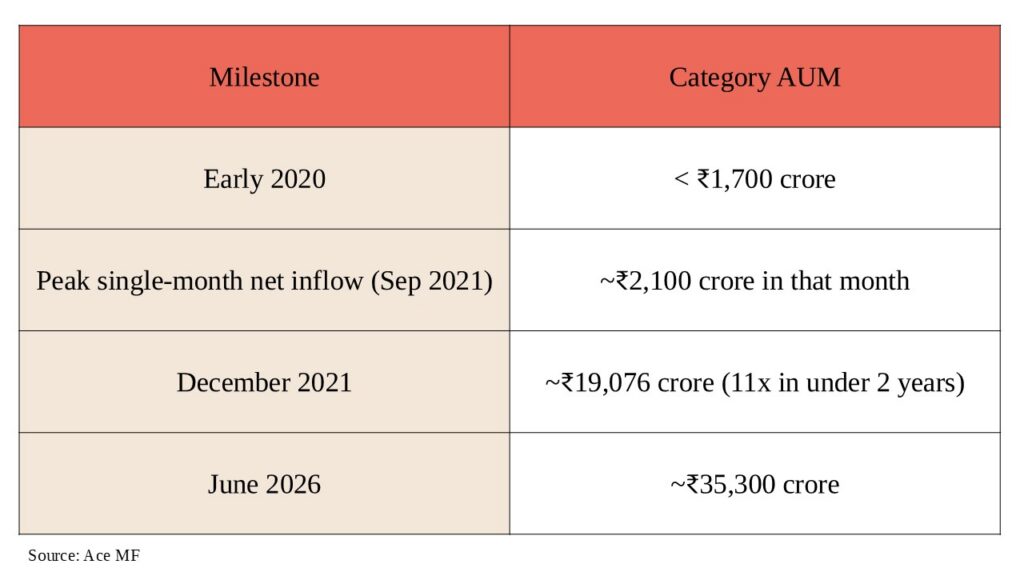
Go back to 2020–21. The category’s combined AUM was under ₹1,700 crore at the start of 2020. By December 2021, it had swelled to over ₹19,000 crore — more than an 11x jump in under two years. The single biggest month for inflows was September 2021, when the category pulled in roughly ₹2,100 crore in that month alone. Money kept pouring in through early 2022 too, with over ₹1,600 crore in January 2022.
This wasn’t random. It was performance-chasing, and the performance was real. Fund-house data on the BSE Teck Index shows FY2021 (April 2020–March 2021) delivered an eye-popping 89% return — the single best year going back to FY2008, and roughly triple the 30–38% gains investors would go on to see even in the good years of FY2022. Across a broader sample of tech funds tracked since 2014, the average CAGR jumped from around 11.6% in the 2014–2018 stretch to roughly 22% in 2019–2022 — almost double — as the pandemic-era digital and cloud rally took hold. By the end of 2021, IT sector had swelled to as much as 19% of the Nifty 50’s weight, a level that reflected just how dominant the sector’s returns had become in investors’ recent memory.
That’s the psychology behind the 2021 flood of money: a sector that had just delivered its best year ever, at a weight in the benchmark investors couldn’t ignore. It’s the same pattern that shows up in almost every hot sector — the money arrives loudest right after the best returns are already behind it, not before. Some of the category’s growth since then has also come from new product launches rather than pure inflows into existing schemes. Since September 2023, eight new technology NFOs have come to market:
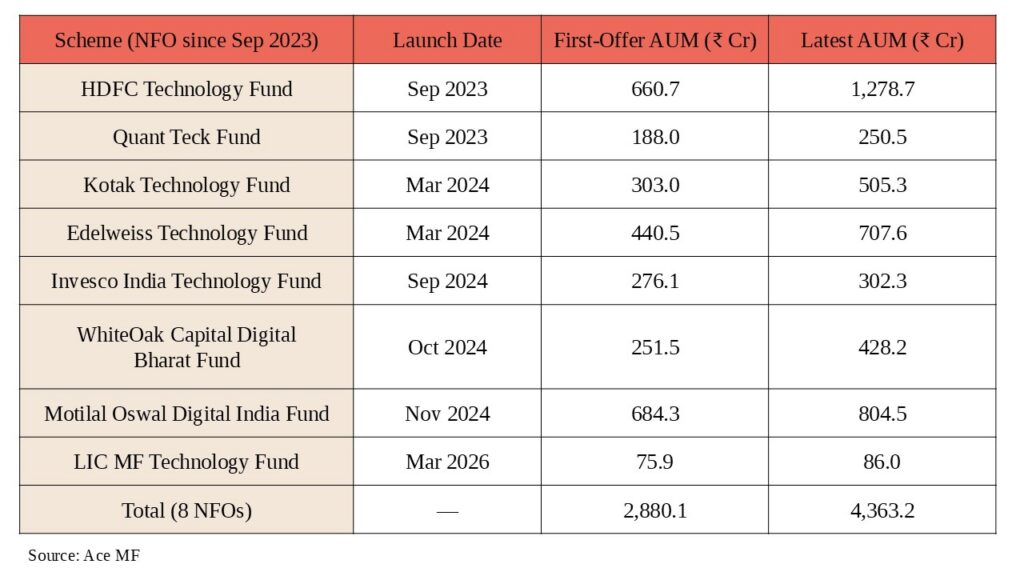
Together these NFOs raised roughly ₹2,880 crore in their initial offer periods and now account for over ₹4,360 crore of category AUM — a meaningful share of the category’s more recent growth, reflecting fresh product launches riding the sector’s popularity as much as existing investors adding conviction money.
What followed the 2021 peak is instructive too. The 2019–2022 CAGR of ~22% has since cooled to roughly 7.3% for 2023 through mid-2026 across the same sample of funds — and IT’s weight in the Nifty has fallen back sharply from its 2021 peak to <8%. Flows since have been choppy rather than one-directional: an inflow of about ₹280 crore in December 2025 and ₹200 crore in February 2026, against outflows of roughly ₹160 crore in March, ₹70 crore in April, and ₹166 crore in June 2026. That kind of back-and-forth is what indecision looks like— investors testing the water, not diving in the way they did in 2021.
The Bull Case
Despite the pain, several arguments are being made for adding to Indian technology exposure:
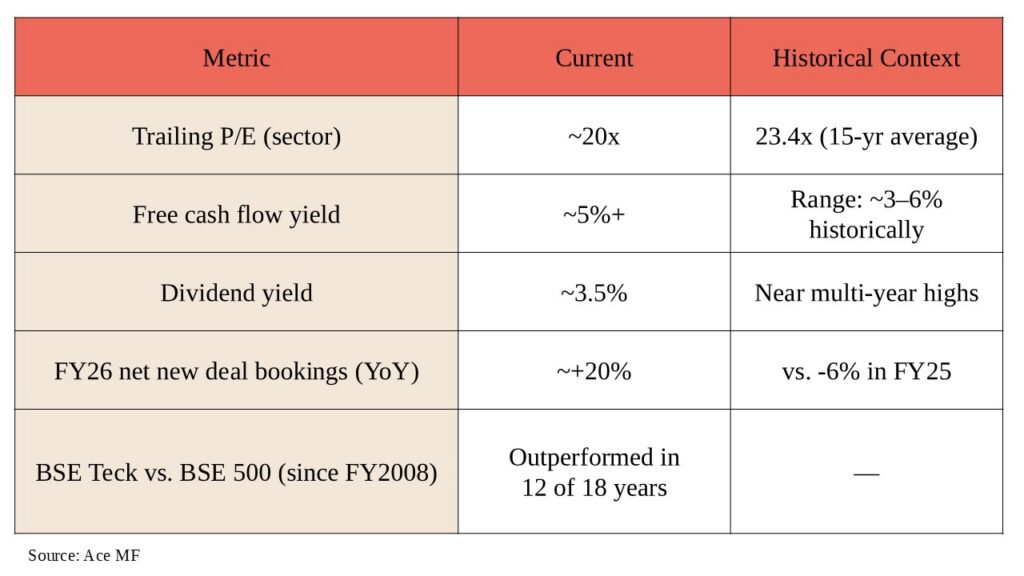
Fund managers are also drawing a direct parallel to 2016–17, when the shift from traditional outsourcing to digital and cloud services triggered similar investor scepticism about Indian IT’s ability to adapt. Growth and margins did wobble then too — but the industry retooled its delivery models and returned to steadier growth. The argument now is that the AI-led transition, while genuinely disruptive, may follow a similar arc. And the long-run scoreboard still favours technology: since FY2008, the BSE Teck Index has outperformed the broader BSE 500 Index in 12 of the past 18 financial years — a track record that argues for staying invested through cycles rather than timing exits around weak years.
The Real Risk: Who Owns “AI Deployment”?
Here’s where it gets more complicated than a simple valuation story. Over just one week in late June and early July 2026, the world’s largest technology companies committed a combined $3.5 billion to embedding their own engineers directly inside enterprise customers — a practice known as forward-deployed engineering (FDE). AWS committed $1 billion to a dedicated FDE unit organised around short, outcome-based engagement cycles. Two days later, Microsoft went further, launching Microsoft Frontier Company with a $2.5 billion investment and roughly 6,000 embedded engineers, backed by clients including Unilever, Novo Nordisk, and the London Stock Exchange Group. Model builders had already moved first: Anthropic formed a $1.5 billion joint venture with Blackstone, Goldman Sachs and Hellman & Friedman in May, and OpenAI launched its own Deployment Company backed by more than $4 billion.
The common thread: Enterprises don’t lack access to AI models anymore. What they lack is the ability to make those models actually work inside their operations — and hyperscalers and model builders are racing to own that gap themselves, rather than leaving it to third-party system integrators.
This matters directly for Indian IT, whose traditional playbook has rested on offshore delivery and labour arbitrage. Infosys has publicly flagged the shift, noting that global demand is pivoting away from legacy technology roles toward AI engineers and forward-deployed specialists, with an estimated 92 million traditional IT jobs at risk of displacement globally against 170 million new roles being created. The company says it’s already running thousands of AI projects and building out its own FDE capability — evidence that Indian IT recognises the threat and is trying to reposition, but also confirmation that the competitive terrain is genuinely shifting, not just cyclically soft.
One Sector, Many Different Bets
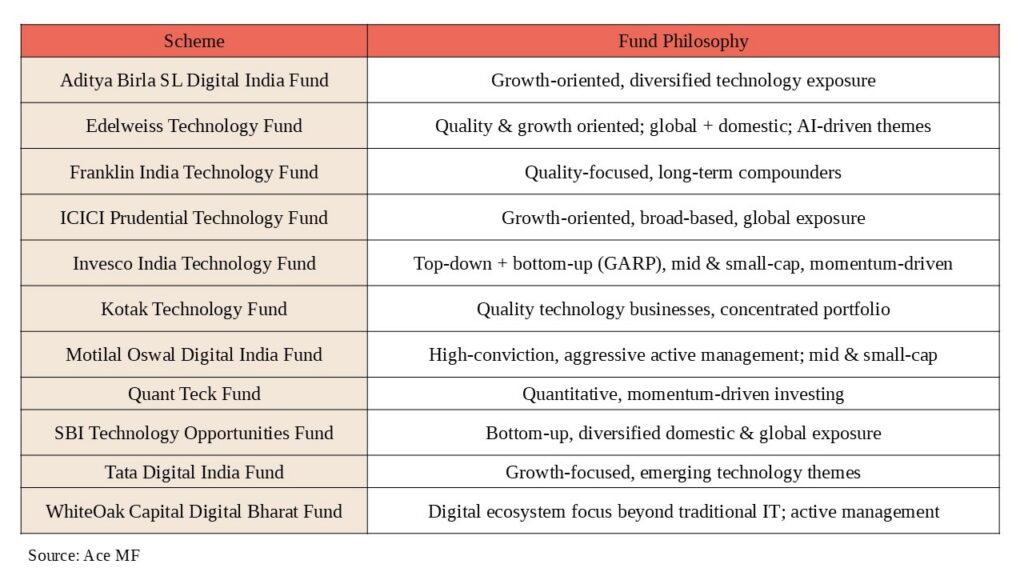
Here’s something worth understanding before picking a fund: “technology fund” doesn’t mean one thing. Across the 13 schemes in this category, fund houses are running genuinely different playbooks, and the return dispersion between them tells you the philosophy matters as much as the sector call itself. Some are pure domestic IT-services plays with a valuation-conscious, low-churn style. Others explicitly go global, blending domestic IT names with international technology and AI-driven themes. A third group leans into mid- and small-cap technology names with a momentum or GARP (growth-at-a-reasonable-price) approach, betting on emerging winners rather than established large-caps. A fourth group runs concentrated, quality-first portfolios of a handful of high-conviction names. And at least one fund defines “technology” well beyond traditional IT services, framing its mandate around India’s broader digital ecosystem.
Who Should Actually Consider This Sector?
Sector funds by design carry concentration risk, and the numbers above make clear that Indian technology has been a genuinely bumpy ride over the past year — and an even bumpier one if you were chasing the 2021 rally at its peak. Based on how domestic fund managers frame suitability, this kind of exposure tends to fit investors who:
- Already hold a diversified core portfolio and are looking to add a high conviction tactical allocation
- Have an investment horizon of 5+ years
- Have a high risk appetite and can stomach drawdowns of 25–35% along the way
- Are investing with long-term wealth creation as the goal
The Bottom Line
Indian technology funds currently sit at an unusual crossroads: valuations and cash-flow metrics that look genuinely attractive by historical standards, a deal-booking cycle that’s turning up again, and a decades-long digitalisation runway that’s nowhere near exhausted — set against a real structural threat from hyperscalers and AI labs racing to own enterprise AI deployment themselves. Neither side of that story cancels the other out.
If you wish to participate in well-researched, timely investment opportunities in mutual funds, Enroll with Milestones2Wealth.

Sources: HDFC Mutual Fund and Invesco Mutual Fund scheme presentations (data as of May–June 2026); DSP Netra sector research; AMFI/scheme flow, AUM and holdings data (July 2026); ithoughtPMS, “Big Tech Is Spending Billions to Own Enterprise AI — Where Does Indian IT Stand?” (July 9, 2026); Microsoft, “Microsoft Frontier Company: AI Engineering That Amplifies and Protects Your Intelligence” (July 2, 2026).