Are you choosing a fund based on its mandate or its manager? Your job is to determine if that manager would make better allocation calls than you would, and if the potential upside is worth the allocation risk.
When it comes to equity mutual funds in India, the choices can feel overwhelming. Two categories often create confusion: flexi cap funds and multi cap funds. While they sound similar and both invest across company sizes, they operate under fundamentally different mandates. Understanding the distinction is crucial for building a portfolio aligned with your goals.
What Are Flexi Cap Funds?
Flexi cap funds are equity mutual funds with the most flexible mandate under SEBI regulations. Unlike other categories, flexi cap funds have no fixed allocation percentages across market capitalizations.
Key characteristics:
- No cap allocation rules — The fund manager can allocate anywhere from 0% to 100% in large-cap, mid-cap, or small-cap stocks
- Manager’s discretion — The entire allocation is driven by the fund manager’s market outlook and stock-picking ability
- Dynamic rebalancing — Weightings can shift dramatically based on market opportunities
To understand flexi cap funds properly, it helps to know the evolution. Flexi cap funds actually came after multicap funds as a regulatory response—and this history shows why both categories exist today. Before September 2020, fund categories were more fluid. Funds labeled “diversified,” or “equity,” had complete freedom to allocate across market caps. This flexibility allowed managers to respond to market opportunities— One fund may have been predominantly large-cap, while another aggressively tilted toward mid and small caps — despite carrying similar labels.
On September 11, 2020, SEBI introduced the multicap category with a clear, mandated structure:
- Minimum 25% in large-caps
- Minimum 25% in mid-caps
- Minimum 25% in small-caps
What This Meant for Flexi Cap Funds
Flexi cap funds were redefined in September 2020:
SEBI essentially said:
- If you want structured diversification → Use multicap (25-25-25 mandate)
- If you want flexible diversification → Use flexi cap (0-100% freedom)
This made the categories mutually exclusive and clear instead of overlapping and confusing.
Flexi Cap Is Fundamentally About Manager Allocation Freedom, So:
→ It’s not constrained by cap size minimums. Unlike multicap’s 25-25-25 structure, there’s no regulatory requirement for any minimum in each cap size. This is the core feature.
→ It’s not automatically diversified. The diversification depends on the manager’s allocation choices, not the category structure. Some flexi cap funds are quite diversified; others concentrate heavily in one cap size.
→ It’s not inherently higher or lower risk than multicap. Risk depends on actual allocations, not the category name. A flexi cap fund at 70% large-cap has similar risk to a multicap fund at that allocation.
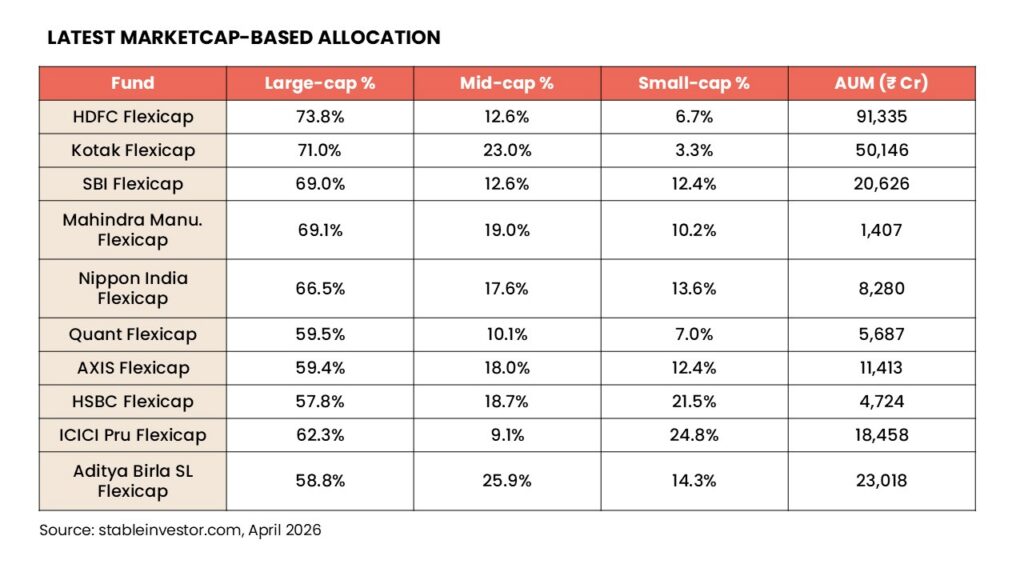
A look at the latest marketcap based allocation in flexicap funds shows that:
- Large-cap concentration is universal: Every single flexi cap fund holds 57-73% in large-caps, averaging 64%
- Small-cap is minimal: Most hold less than 15% in small-caps
- Range is narrow: Despite complete 0-100% freedom, managers cluster within a 16% band (57-73%)
The Real Value of Flexi Cap Funds
Flexi cap funds serve a specific purpose in India’s mutual fund ecosystem. They’re not universally “better” than other categories—they’re different in a meaningful way.
What Flexi Cap Offers:
- Allocation freedom: The manager can shift between cap sizes based on their analysis of valuations and opportunities
- Strategic flexibility: Unlike multicap’s fixed minimums, a flexi cap manager can fully concentrate on an attractive segment if conviction warrants it
- Outcome-focused: The focus is entirely on finding good stocks and positioning appropriately for them
What This Requires From You As An Investor:
- Trust that the specific manager can make good allocation and stock-picking decisions
- Comfort with volatility from allocation shifts
- A long time horizon for allocation calls to play out
- Ability to evaluate manager skill beyond just past returns
Your job is to determine if that manager would make better allocation calls than you would, and if the potential upside is worth the allocation risk.