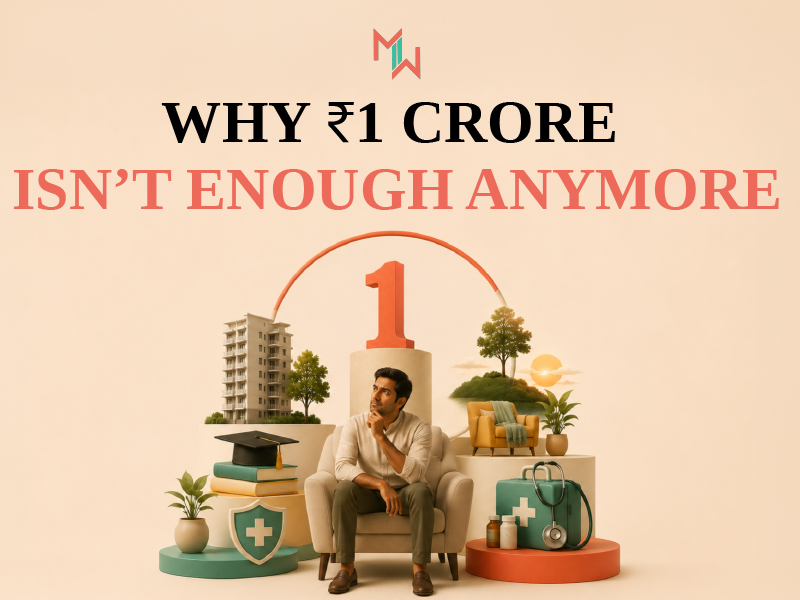
For years, ₹1 crore was seen as the ultimate symbol of financial success. But in today’s world of rising inflation, soaring housing costs, expensive education, and longer retirements, is it really enough? This blog explores why ₹1 crore is no longer the finish line, how to calculate the wealth you actually need, and why true financial freedom starts with a plan built around your life—not someone else’s number.
“I want to be a crorepati.”
We hear this all the time. Your parents say it. Your friends say it. Maybe you even think about it when you look at your savings.
For a long time, ₹1 crore was the ultimate dream in India. If you had that much money, people thought you were rich, and your life was set.
But let’s be honest. Times have changed. The number looks big, but it does not buy as much as it used to.
If someone had ₹1 crore back then in the year 2000, they could buy a big house, pay for their kids’ college, and still have plenty of money left to retire comfortably.
Now look at today.
The number is the same, but prices are completely different.
Take buying a house, for example. In any big city, a simple 2 or 3-BHK flat can easily cost above or around ₹1 crore. After you pay for the taxes, interior, and furniture, all that savings is gone. Your entire dream is now just one apartment.
Next is education. School fees and college costs are shooting up every year. What used to cost a few thousand now costs lakhs. If your kid wants to become a doctor, engineer, or study big courses, it takes a massive amount of money.
Healthcare is another big problem. Even with medical insurance, it does not cover everything. Medicines, regular checkups, and hospital stays are becoming more expensive every day.
But the biggest mistake people make is with retirement.
Imagine your family spends ₹70,000 every month right now. If you are 35 today and plan to retire at 60, you cannot assume your expenses will still stay at ₹70,000. With long-term price rise expected to be at 6% every year, that same lifestyle will cost you ₹3,00,000 every single month by the time you turn 60. Just to buy the same groceries and pay the same bills. Plus, thanks to modern medicine, we live much longer now. If you retire at 60 and live until 85, your money has to last for 25 long years.
So, is saving ₹1 crore pointless? Absolutely not.
Getting to your first crore is a huge win. It takes years of hard work, discipline, and saying “no” to things you want right now. You should definitely celebrate it.
But the mistake is thinking that you can stop working or stop planning once you hit that number.
Real financial freedom is not about chasing a fixed, most famous number that everyone loves. It is about your own life and your own needs.
So, stop asking, “How do I reach ₹1 crore?”
Instead, ask yourself: “What is the actual cost of the life I want to provide for my family today, and the peace of mind I want when I grow old?
For one family, a smaller amount might be fine. For another, it might take Rs 3 crores or 5 crores to live without stress. Don’t copy someone else’s target. Figure out your own cost of living, because true wealth means your money never runs out while you are alive.
At Milestones2Wealth, 1 crore is just the starting point. We help you move beyond chasing numbers by building a personalized financial roadmap that turns your life goals into achievable milestones.