
Most individuals today are earning more than ever before. Access to investments has never been easier — mutual funds, SIPs, and equity markets are all available at a tap. And yet, meaningful wealth creation remains rare. Not because people are careless. Not because they lack awareness. But because somewhere between knowing and doing, structure is missing.
There Are Two Versions Of Your Future Self:
- One who says, “I’m glad I started early and stayed consistent.”
- Another who says, “I should have planned better.”
The difference between these two is rarely income or luck. It is almost always clarity and structure.
Today, many salaried professionals invest and hold multiple products. Yet if asked — What is your net worth? Which investment is for which goal? Are you on track for retirement? — the answers are often unclear.
When Portfolios Look Busy but Achieve Nothing
It is very common to see portfolios that include three to five SIPs, one or two insurance policies, and some savings accounts or fixed deposits. On the surface, this looks responsible. But underneath, there is often no linkage to real-life goals.
Investments are typically driven by market news, tax deadlines, peer suggestions, or recent fund performance. This is reactive investing — not planned investing. The outcome is a portfolio that is active, has money deployed, but is not working toward anything specific.
Think of it like exercising without a programme. You feel productive — but you are not progressing toward a defined result.
What Actually Builds Wealth
At its core, wealth creation depends on three pillars working in harmony:
1. Goal Clarity
A clear amount, timeline, and purpose. Not “I want to save more” — but “I need ₹45 lakh by 2030 for a home down payment.”
Setting the amount, the timeline and purpose is one thing. But the real question is: Are you setting aside sums for goals at today’s cost? What will the amount actually mean in the future? Due to inflation, purchasing power reduces significantly over time. The real value of Rs 1 crore, for example, will just be Rs 55- 60 lakhs after 10 years and Rs 30-35 lakh after 20 years.
Hence, for each financial goal, define:
- Target Amount — adjusted for future value
- Timeline — the exact year you will need it
- Inflation Adjustment — what today’s cost becomes tomorrow
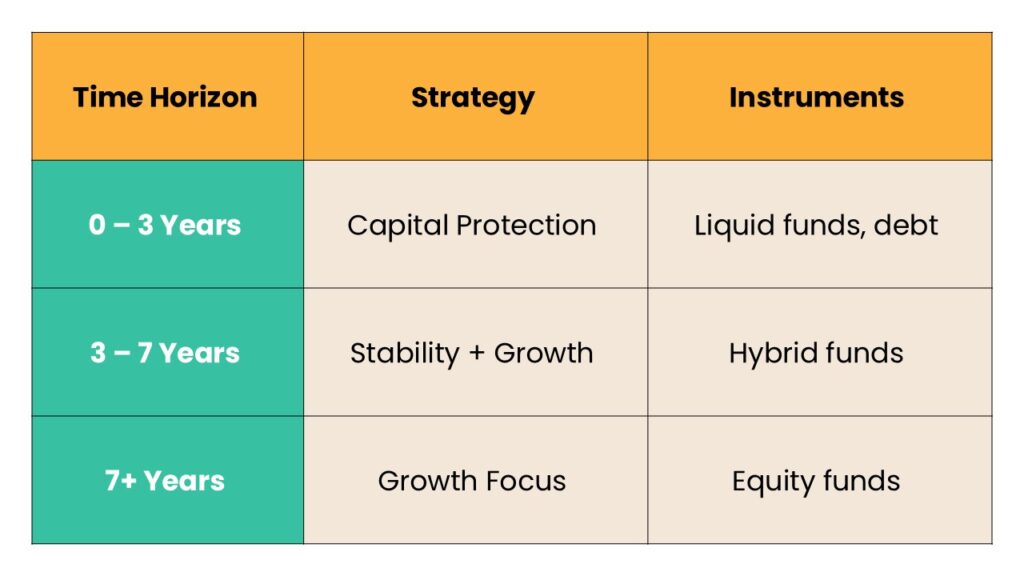
- Matching Investment Strategy — aligned to the goal’s horizon
2. Asset Allocation
Many investors focus on which fund to choose, past returns, and industry rankings. But long-term success is driven primarily by asset allocation:
- Equity — for growth
- Debt — for stability
- Liquid — for flexibility
Consider the difference: 80% equity exposure for long-term goals creates strong wealth-building potential, while 80% fixed deposits are likely to produce a shortfall against inflation over the same period.
Goal-Based Allocation Framework
3. Behavioural Discipline
The ability to stay invested during volatility, continue SIPs during downturns, and avoid chasing trends. Without this, even the best-constructed portfolio can unravel.
A Practical 5-Step Framework
- Define Goals Clearly — Write each goal with a specific amount and timeline. Precision is the foundation of planning.
- Adjust for Inflation — Convert today’s cost into the future value you will actually need.
- Calculate Required Investment — Work backwards from the future value to determine the right SIP amount today.
- Match Investments to Goals — Align instruments with timelines, not with market sentiment.
- Review Annually — Track progress, step up SIPs as income grows, and rebalance when needed.
The Quiet Difference
Wealth is not built through dramatic decisions. It is built through consistent SIPs, thoughtful allocation, periodic reviews, and the discipline to stay invested during uncertainty. There is no shortcut. The individuals who achieve meaningful financial milestones are not necessarily the highest earners or the most informed. They are the ones who started early, structured their finances, and stayed disciplined.
If your current investments are not linked to goals, do not have timelines, and are not reviewed regularly — the issue is not effort. It is structure. And that is something you can fix. Reach out to Milestones2Wealth today!